
Historical Data Archive (H-DATA)
The Historical Data Archive (H-DATA) is a hub of historical country-level data going as far back as the French revolution or even further.
| Host | Stockholm University |
|---|---|
| Website | H-DATA |
| Key Theme | Historical Data |

H-DATA is a hub of historical country-level data going as far back as the French revolution or even further and offers unparalleled depth of data and temporality, enabling researchers to answer critical questions about the past but to also understand the origins of, and find historical parallels to, present-day problems.
By adding this long-term historical dimension, H-DATA makes it possible for researchers to study the path dependency of political institutions where changes are incremental or rare thus making long time-series essential to understanding their causes and consequences. By extending data back into time, H-DATA helps deepen and further our understanding of the conditions of the complex global challenges that we face today.
H-DATA works to collect, integrate, and curate historical data from Demscore’s other modules. The Demscore infrastructure includes five datasets from H-DATA, covering a time span from 1750 to 2017.
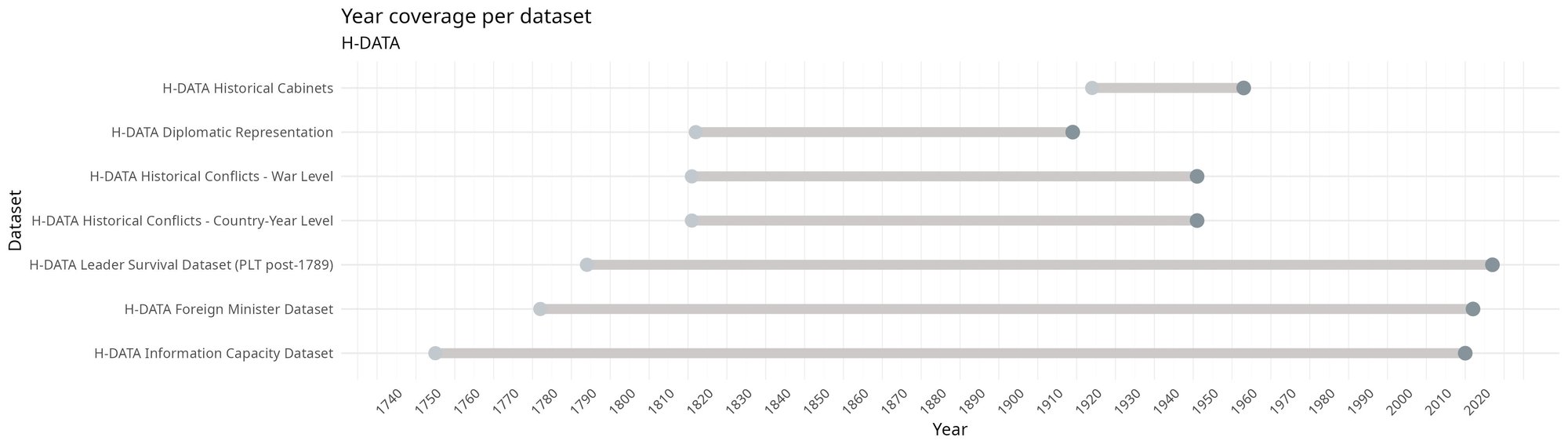
The following section provides an overview of the data sources provided by H-DATA and how they are prepared and included in Demscore.
H-DATA Information Capacity dataset offers numerical data on five institutions and policies that modern states use to collect information about their populations and territories: (1) the regular implementation of a reliable census, (2) the regular release of statistical yearbooks, the operation of (3) civil and (4) population registers, and (5) the establishment of a government agency tasked with processing statistical information. The dataset also includes an overall index of “information capacity” for 85 polities from 1750 to 2015.
The H-DATA Foreign Minister Dataset consists of comparative historical data on foreign ministers’ background and reasons for leaving office in the world’s 13 former and current great powers from 1789 to the present. The data covers 1155 regular (non-acting) foreign ministers, as well as partial information on 173 acting foreign ministers, for the following 13 great powers: Austria (the Habsburg Empire/Austria-Hungary), Britain, China (Qing Empire/Republic/People’s Republic of China), France, Italy, Japan, the Netherlands, Prussia/Germany, the Ottoman Empire/Turkey, Russia, Spain, Sweden and the United States.
The H-DATA Diplomatic Representation dataset builds upon the Correlates of War (COW) dataset Diplomatic Exchange, 1817-2005 (v2006.1) by expanding the country and temporal coverage of diplomatic representation during the 19th century by including states that have been excluded from the COW sample. The dataset is dyadic with each row containing two sets of identifiers, with the key variable being the level of diplomatic representation of country 2 by country 1.
The Historical Cabinets (H-CAB) dataset is an historical extension of the Party Government in Europe Database (PAGED) and covers cabinets formed between 1919-1945 in 12 European countries. In addition, new data for France was also collected for the period 1945-1958, covering the Fourth Republic which is not included in PAGED. The H-CAB dataset provides data on dates of cabinet formation and dissolution, along with data on the cabinet party composition, allowing for analysis on cabinet formation and duration during the interwar period.
The Historical Conflict Dataset (HCD) dataset merges multiple existing datasets on wars from 1816-1945 to create a comprehensive list of interstate, intrastate, and extrasystemic wars during this time period. It uses an expanded definition of statehood from the International System(s) Dataset to reduce the Eurocentric bias in defining what constitutes a state and reclassifies war based on a more inclusive definition of statehood. The dataset aims to increase ease of access to war data, particularly for scholars working with country-level historical data between 1816 to 1945. The data is available in two formats: country-war and country-year.
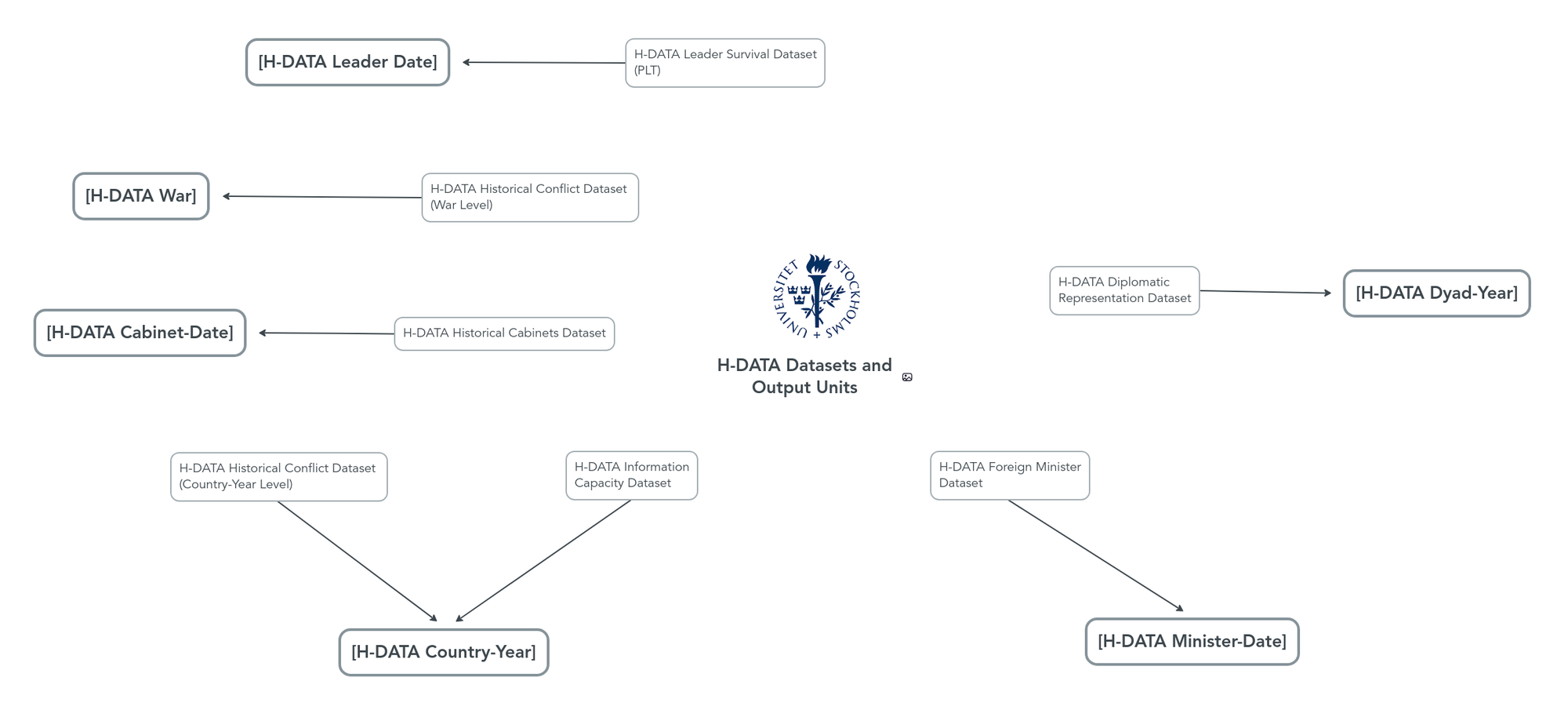
Variables from H-DATA datasets in Demscore are available in their original form in the datasets’ respective Output Units. The figure below shows all Output Units we identified for H-DATA and which datasets belong to each.
All H-DATA variables can be retrieved through all other Output Units within H-DATA. The figure below is an overview of which variables can be retrieved in which other Output Units within this Module. The labelled arrows further indicate which aggregation methods we use and in what way observations are translated to each other.
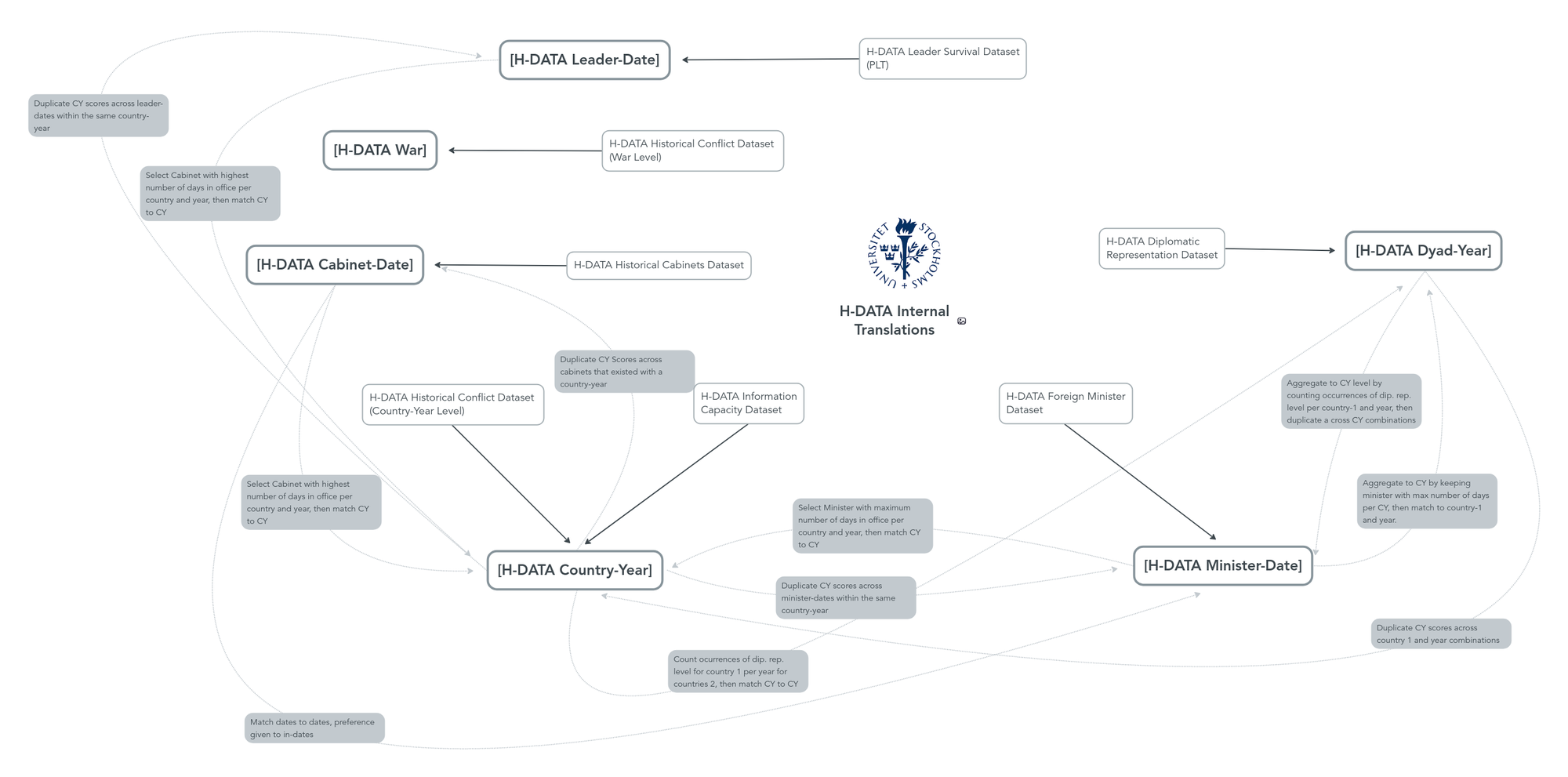
Added are also translations between H-DATA Output Units and Output Units from other Modules that can be read up on in the Demscore Methodology Document.

You can find a detailed explanation of all Units and more information on their programmatic construction on the Documentation page and in the Demscore Methodology Document.